


What is in your Genome?

By now you should be quite aware of the fact that DNA contains all the information about you. Your DNA holds information about the color of your skin, your height, your fingernails. When think about it, this is something quite amazing. Everything about you, your parents, your grandparents, is kept in a small bit of acid called DNA.

Now what would you do if you had all the information inside of your DNA sitting right in front of you, all laid out and known. Information such as that would be very valuable. The race is on to “decode” human DNA. Many people around the world are working together to read what’s called the human genome. In this section of Genetics R Us, we are going to learn what a genome is.
If your remember, sperm and egg cells are very important cells. They are used by your parents to create you. Each sperm and egg cell contains DNA from each of your parents.
Now let’s take, say an egg cell, and let’s pull out the DNA. After we pull out the DNA, let’s stretch it out completely and then use a ruler to measure it. If we that do, you’ll find out that there is approximately six feet of DNA that is inside an egg cell. The same is true for a sperm cell. That six feet of DNA is what is known as the genome.

Because an egg and sperm cell represents you, the DNA inside each of those cells contains everything about you. A common goal of many researchers today, is to be able to completely “read” a genome. By “reading” a genome, I mean gathering all the information that’s contained in the genome, in particular, the human genome. This goal takes the form of what is known as The Human Genome Project. Before we get into the HGP, let’s take a detailed look at a genome so you can understand a little better.

Three Levels of the Genome

The first thing you have to understand is that a genome can looked at in different ways. These “ways” can be thought of as different levels. There are three basic levels to a genome, the DNA level, the gene level, and the allele level. In each level, different information can be gathered which tells us new things about the genome, and a person as well. Let’s begin by first taking a look at a genome at the DNA level.

If you remember, DNA is made of four bases, adenine, thymine, guanine, and cysotine. Watson & Crick discovered that adenine pairs with thymine and cysotine pairs with guanine. Therefore, a genome can viewed as having a certain number of base pairs. This is the size of a genome. The size of a genome is referred to as the C-value.
It used to be thought that the more “complex” a living organism is, the larger its genome or C-value must be. This makes sense if you think about it. For example, humans are much more complex than say, frogs. We can do things a frog cannot even try to do. Then you might say to yourself, “Well, since we humans are more complex than a frog, we must have much more DNA than them.” In other words, you might think that we must have a much larger genome than a frog. However this is not case. In fact, frogs have ten times much more DNA than we do!!! A situation like this is known as a paradox. This particular paradox is known as the C-Value Paradox. Let’s take a look at the next level, the gene level.
If you remember, a gene is a segment of DNA that holds instructions to make a protein. Your cells “read” genes to make proteins. There are some segments of your DNA that your cells don’t read. These areas are called non-coding DNA segments. A genome therefore has a number of genes on it that make it up. This is the considered the most important level.
Because a gene holds information is why this level is considered the most important. However, identifying a gene and knowing what a gene does is two different things. When a gene has created a protein, that protein has two places it can go. It can stay within the cell that created it, or it can go somewhere in your body to perform an important task. In both cases, tracking a protein is a very difficult task. The main reason is for this is the technology to track the routes of newly made proteins simply is limited. Because it’s hard to track a protein, it’s hard to what a protein is doing in your body. Nevertheless, the reading of the human genome continues to take place.
The third and final level is the allele level of a genome. An allele is simply different versions of the same gene. Because a genome has a certain number of genes on it, it might also has a certain number of alleles on it. This level of the genome has the most information because a gene may have many alleles. Many geneticists don’t focus on this level of the genome.
The reason is that this level of the genome would simply just give the number of alleles that a gene would come in. Most geneticists aren’t interested in this, because the number of alleles a gene may have is very limited information. Simply put, nothing else done with this information. Geneticists are mostly interested in determining the number of genes a genome has, and even more important, what a gene does in terms of its protein. In other words, the function of a gene is what geneticists look for. This interest of geneticists takes the form of what is known as genome projects. Let’s take a look!!!!

The Human Genome Project

Now that you understand what a genome is, you can now understand a genome project. A genome project is simply a process where every gene that makes up a genome is identified. Next, these genes are then placed into a large database so other geneticists can further do his or her own research. An example of this shown toward your right.
Locating a gene within a genome is not an easy task. You simply cannot look at DNA and say, “Oh, there’s one gene, and oh my goodness, I think I see another one.”
For example, take a look at this DNA shown toward your left. Can you simply just pick out some genes? Of course not!!!! It’s not that simple. How genes are found will be discussed later.

At this point, let’s talk about a genome project that is of great importance for you, me, and every person living on the planet, The Human Genome Project.

Micro DNA

The Human Genome Project, or HGP, is the genome project that is attempting to identify all the genes the make up the human genome. It was begun by the U.S. in 1990 with funding by the Department of Energy and the National Institutes of Health. It’s expected to be completed by 2005.


It’s important to know that this task is not just being done by one or a small group of individuals. The HGP is being worked on by people from all over the world. Nevertheless, two groups have emerged as the front runners in the HGP as they have gathered the most information from the human genome.
The first group is the National Human Genome Research Institute, or NIH. It’s director is Francis Collins. The other group is a private corporation Celera Genomics which is stationed in Rockville, MD. It’s president was Craig Venter, because recently he was replaced by someone else.
In June 2000, USA Times announced that the Human Genome had been completely sequenced. Boy were they wrong.

Here’s is what we know

  1. The number of genes turned out to be much smaller than once predicted. There are about 30 to 38 thousand human genes.
  2. Human DNA is very repetitive.
  3. Humans have many genes not found in invertebrates, such as insects and worms.
  4. Humans have many genes found in bacteria.
During June of 2000, both Celera Genomics and the NIH announced that they were nearly complete with the HGP. It turns out that both groups have read about 90 percent of the human genome. In reality, what both groups have is basically a “rough draft” of the human genome.

Shown toward your left is a basic summary of what both groups have discovered about the human genome.
While the work of both the NIH and Celera is remarkable, there is still is much work to be done. There are still many gaps that must be closed. In addition, the function of those sequenced genes has yet to be determined. In other words, what is the job of a protein once it is encoded by a gene? Locating a gene is one thing, but knowing what that gene does is something else. This will be the biggest task for many researchers. What that in mind, let’s take a look at some completed genome projects of other organisms.
Fly
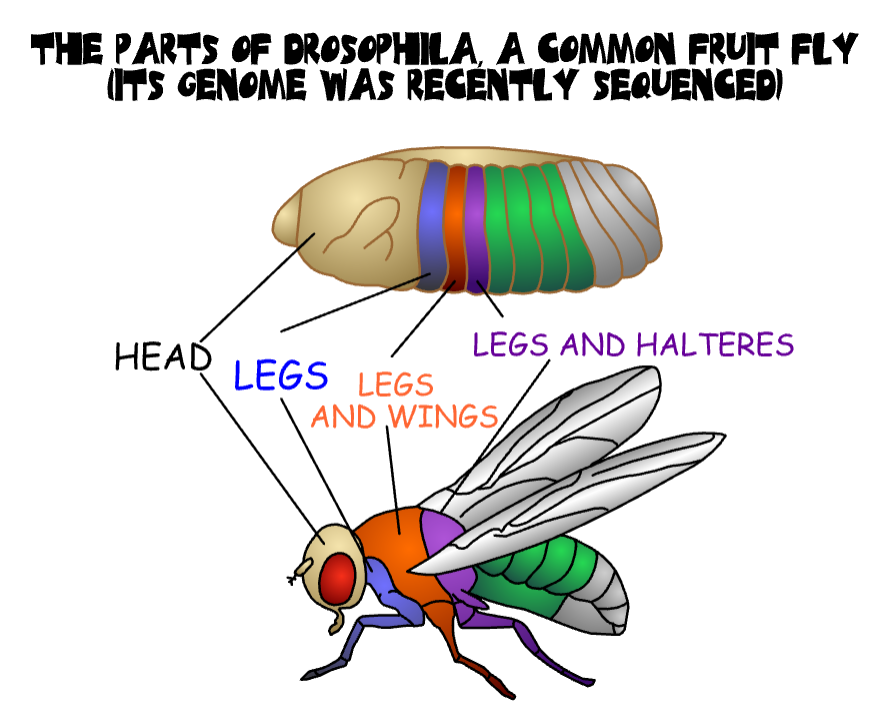
The common fruit fly known as Drosophila melanogaster, (what a name!!), recently had its genome completely sequenced during June of 1999. Its C-value, (or genome size), is 122,653,977 base pairs. It has 13,472 genes at the gene level.

The genome of Caenorhabditis Elegans recently made the history books. It was the first multicellular life form to have its entire genome sequenced. C. elegans is a nematode, which basically is a very small soil worm. Its C-value is 9.5 million base pairs. It has 19,820 genes. C elegans has helped understand a process known as apoptosis, which is the time when a cell dies. This has helped in cancer research.
Mendel
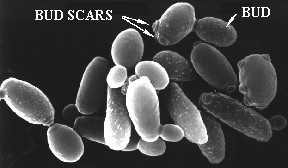
Next on our list is Saccharomyces Cerevisiae. (Don’t ask me, I didn’t make up the names). This is baker’s yeast. It’s genome has 12,495,682 base pairs. It has 5770 genes at the gene level.

In total, there are about 49 genomes of 49 different living organisms that have been completely read and sequenced. Currently, there are genomes of other organisms that are being read. Here’s a link to the completed genomes of other organisms. At this point, you’re probably wondering why “reading” a genome is so important. In the next section, we are going to see why understanding the genome is so important.

Why Genomes are Important!!!

A genome is important because it gives us information about an organism. This is the obvious reason why a genome is important. This point really hits home when we study the genomes of other creatures. Here is what is meant.
Over the pass 15 years, there has been a huge increase in DNA technology which are the machines used to gather information about DNA, genes, cells, proteins, etc. Technology is important, because without it, what’s put on the blackboard, cannot be actually applied within the real world. Toward your left are advancements in DNA technology.
Eukaroytes
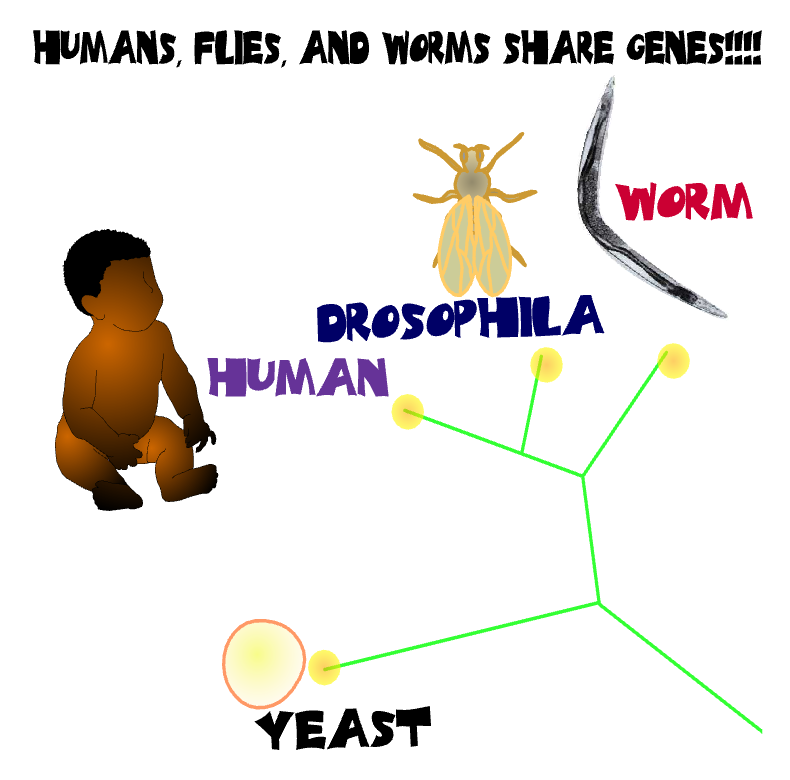
One of the things that DNA technology has done is that it has shown us that many different organisms share many of the same genes. For example, 40 percent of genes found in baker’s yeast, are found in humans. This is no coincidence. The reason for this is that humans and yeast are related.
By understanding the genome of one organism, we can learn about ourselves. In addition, we can experiment on other living things, without having to experiment on ourselves. In fact, studies of baker’s yeast helped us understand how cells divide and multiply. Genes are responsible for cell division. Those same genes that cause a yeast cell to divide are present in humans. Because the yeast’s genome is completely known, those genes, all of them, can be studied and cell division can be completely understood. Now you see why a genome is important. And presto, now you know what a genome is, courtesy of Genetics R Us.