

DNA Replication

Welcome back to Genetics R Us!!!!!!! I hope you enjoyed the last section on enzymes!!!! Enzymes are very important, and in section of Genetics R Us, we will see this!!!!! If you have not read the section on enzymes, then you might want to click on this link. The importance of enzymes can be seen within the process of DNA replication. DNA replication is the process where a single DNA strand divides and becomes two new DNA strands. This eventually leads to a single cell becoming two new cells. As always, Genetics R Us will make it easy for you, so let’s begin!!!!!!
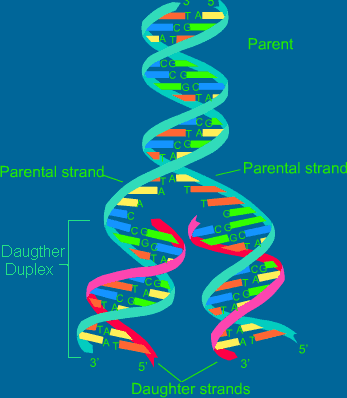
Let’s begin by looking at a basic picture of DNA replication. Shown toward your right a basic single strand of DNA. DNA replication involves a single DNA spliting to become two new DNA strands. These new strands are called daughter DNA strands. Place your mouse over the single DNA strand to see the replication.
The snapdragon disobeys Mendel's laws
Watson and Crick discovered that when DNA replication occurs, it happens in a semiconservative fashion. What this basically means is that each new daugther DNA strand is made up of one half of the original, and the other half is a new strand. You can see this in the model toward your left. The red portion in the model is the newly synthesized daugther strand and the green portion is the original parent strand.
While the animation above shows basic DNA replication, it is very much oversimplified. In other words, the animation is just too darn simple and easy! Believe it or not, DNA replication involves much more than what is shown above. Remember earlier, it was stated that enzymes play a major role. To make long story short, enzymes actually physically touch and perform work on a DNA strand.
Remember enzymes are encoded by enzymatic genes. The most important point to grasp is that a DNA strand has genes on itself which it uses to make proteins to perform work on itself. If what I said just confused you, then take a look at the model toward your right.
A DNA strand makes enzymes that it uses on itself to replicate.
Before we take a second, more detailed look at DNA replication, let’s meet the all important enzymes which make the DNA replication happen.
First on our list is helicase. Helicase has the important task of opening a DNA strand so the replication process can begin. Shown toward your right is an animation of helicase at work!!! It is shown in yellow.
Second on our list are the SSB proteins. SSB stands for Single Stranded Binding protein. Research shows that the SSB has many functions but it’s main job appears to be stabilizing each half of the parent strands as helicase unwinds the parent strands.
Third on our list is most the important enzyme. Meet DNA Polymerase. Actually,there are three of these suckers, DNA Polymerase I,II,&III. The one we are interested in is DNA Polymerase III. It has the important task of generating a new DNA strand by adding new nucleotides.

The fourth and final enzyme actually seals the deal. Meet DNA Ligase. The purpose of DNA ligase is to “seal up” adjacent new DNA nucleotides as DNA Polymerase synthesis them.
There are a number of other important replicating enzymes involved within DNA Replication. This is especially true in considering eukaroytes. These enzymes include DNA Primase, Gyrase, and Topoisomerase. Oh yeah!!!!, it’s not a nice walk in the park. But Genetics R Us will do its best to make it easy for you!!!!
Here’s a basic overview of what this section of Genetics R Us will cover in a moment. While there are terms in this model which haven’t been explained yet, the most important thing to understand are the enzymes seen here at work. The new DNA strands, shown in red, are being created by enzymes.
types
With that in mind, let’s now begin to take an animated detailed look at DNA replication. As we proceed thru the rest of this section, keep in mind that new terms will be introduced. If you get confused, then simply keep refer to our colorful replication model shown above this paragraph. Let’s begin!!!!!
Let’s start off with a basic double strand of DNA. At this point, let’s refer to DNA strands as template strands. For replication to happen, the DNA strands must be opened. Helicase simply unwinds the template strands. Helicase is encoded by the helicase gene.
As helicase unwinds the template strands, there’s a chance that the opening strands might be become unstable and reclose. The SSB protein takes charge. It binds to each template strand to keep stability as replication continues. Research shows that the SSB proteins have other talents as well.
As the DNA strands are being opened by helicase, there is a tendency for tension to arise on certain regions of the DNA strands. This tension usually leads to regions of DNA that become overwounded. A special enzyme called Topoisomerase creates a small cut in the overwounded DNA, to allow the overwounded DNA to unwind and relax.
At this point, let’s call the open DNA a replication bubble. Inside the DNA bubble, an enzyme called primase, starts the DNA replication, by adding a small piece of RNA. Yes that right, RNA, (not DNA), is added to the inside of the DNA bubble. This allows our most important enzyme, DNA Polymerase III, to begin its all important work.
With the small piece of RNA, (which called an RNA primer), added to both sides of the DNA replication bubble, DNA Polymerase III begins to generate two new DNA strands. The purpose of the RNA primer is to give DNA Polymerase III a starting point. As this is happening, helicase contines to open and unwind the DNA bubble, making it larger.
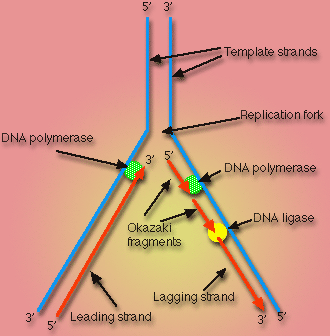
As DNA Polymerase III makes new DNA strands, it will generate two types of DNA strands, a leading and lagging strand. The leading strand is long, continous, DNA strand. The lagging strand is composed of short, seperate DNA fragments, which are called Okazaki fragments.
Okazaki fragments were discovered by a Japanese biochemist, Reiji Okazaki. More important, notice that each Okazaki fragment has an RNA primer attached to it. Now of course, RNA cannot remain inside of the DNA replication bubble. Remember, we are dealing with DNA sythesis, not RNA synthesis.
Because RNA has nothing to do with DNA formation, each RNA primer must be removed. An enzyme called DNA Polymerase I, comes along and removes each RNA primer. However, we now have a new problem. The removal of the RNA primer has left a small open gap in the lagging strand. An enzyme called DNA ligase comes along and seals up the open DNA gaps with fresh, new DNA!!!

And there you have it!!!! Two completely brand new DNA daugther strands. Looking at DNA replication from this viewpoint, one might think that the process is fairly simple. Based on our current facts about DNA replication, there’s nothing really complex about DNA replication!! It’s just a number of different steps you have to remember.

However when considering DNA replication within eukaroytes, then there are number of steps that we didn’t cover. For example, given that a eukaroytic genome is fairly large, how is it determined where on the eukaroytic genome should the replication begin? Should the replication start at one end, or maybe the replication should start dead smack in the center of the DNA strand. In the next part of this section of Genetics R Us, we are going to briefly look at the finer points of DNA replication in eukaroytes. So strap on your seat belts!!!!!!

Eukaryote Replication

Believe it or not, DNA replication in eukaroytes is not fairly difficult to understand. What was discussed above was a general overview of DNA replication. DNA replication is pretty much similar in all current living organisms on Earth. Let’s take a look at the finer points of DNA replication in eukarotyes so you can get the complete picture.

The first question we need to address is how is it known where on a eukaroyte genome, replication should begin . A eukaroyte genome is fairly large. For instance, the human genome is six feet in length. How does a cell know where to start replicating a DNA strand?
The answer to this problem is solved by the use of what’s called an origin of replication. This is basically a “hotspot” on the eukaroyte genome where DNA replication is chosen to occur. The origin of replication is essentially a sequence of DNA bases which sometimes called a oriC. A group of initiator proteins binds called the oriC and helps start the unwinding of the DNA.
The second finer point of eukaroytic DNA replication is to review the actual formation of the leading and lagging strands. Having a firm understanding of this will indeed complete your understanding of the fundamentals of DNA replication in eukaryotes!!!!
The star of DNA replication is DNA Polymerase III. Remember that there is both a leading and lagging DNA strand that’s being generated at the same time. This requires two DNA Polymerase III enzymes. More important, each DNA polymerase III protein has a primase protein, (shown in red), attached to it. This called an enzyme complex.
Each enzyme complex moves with the entire DNA complex as it’s being replicated. On the leading strand, its enzyme complex remain attached to it. On the lagging strand, its enzyme complex is NOT attached to it. On the lagging strand, replication starts with the RNA primase adding an RNA primer to it.
Because of the difference in replication on both the leading and lagging strand, the lagging strand DNA tends to “loop out” between the parent template DNA and the enzyme complex. Take a look at the animation toward your right to see this occuring.
Once DNA Polymerase III creates a fresh new Okazaki fragment, it will detach itself from the DNA parent template and the RNA primase protein. Primase then produces an RNA primer on the lagging strand. DNA Polymerase recombines with the primase enzyme so that synthesis of the lagging strand can continue.
By this mechanism, the two enzyme complexes can create new DNA strands at a pretty fast rate. To be more specfic, this mechanism can add new DNA nucleotides at a rate of around 1000 base pairs each second. Check out the animation toward your right to see the whole entire synthesis of the lagging and leading strands.
And there you have it, the Genetics R Us tutorial on DNA replication. Yeah, I know, it was a lot of information to take in and digest. If you think this was much, then imagine the pain I had to endure to create this section of Genetics R Us. However the pain is worth it, so you, the reader, can understand the DNA replication process as easy as possible. Till next, see ya!!!