

Transcription
Welcome back to Genetics R Us. Oh Yeah, once again its time learn new things within the world of genetics. Our next stop takes us into DNA transcription. In our previous article, we looked at DNA replication. While not as involved as DNA replication, DNA transcription is a fascination process. In this section, we are going to study DNA transcription and see it’s importance within biological organisms. So let’s get started!!!!!!
Simply put, DNA transcription is the synthesis or creation of RNA from DNA, or DNA template to be more specfic. This process happens inside of your cells and is the intermediate step taken during the expression of gene. Shown toward your right is central dogma of life. I am sure you remember this right? The red structure in the middle is RNA.
Central Dogma of Life showing transcription.
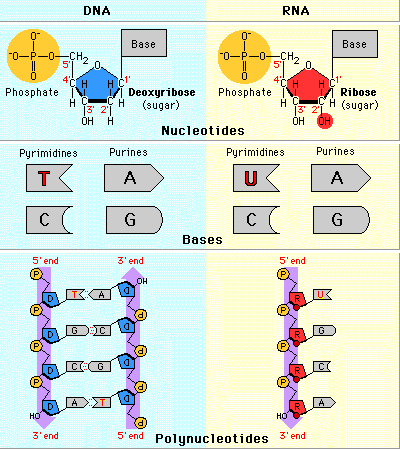
You know about RNA right? Okay, here’s a little tutorial. Like DNA, RNA is an acid. It has four bases: Adenine, Thymine, Cystoine, and Uracil. Yes Uracil, not Thymine which is present in DNA. This is a major difference between RNA and DNA. Another difference between DNA and RNA is that while DNA is double stranded, RNA is single stranded as you can see toward your left. However the biggest discovery made was that RNA is also an enzyme. This means RNA was around long before DNA making life happen!!!!!!!!
But enough about RNA, let now take a look at the actual process of transcription. Let start with a simple animation. Take a look at the “skeleton” animation below. I like to call it a “skeleton” animation because it shows the bare bones. In other words, it’s very easy animation to grasp and understand.
Now place your mouse over the animation and click your mouse as you like!!!
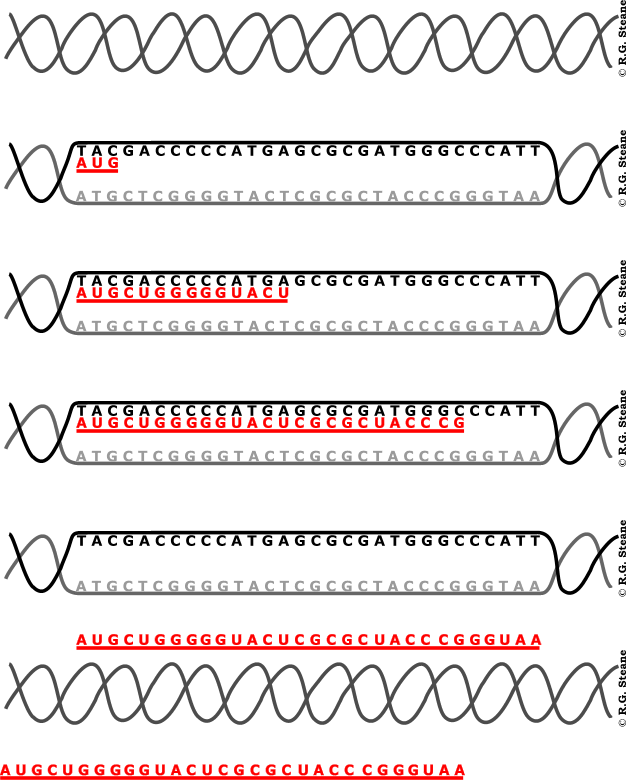
Cool huh!!!!!! There are two things to note. First, the RNA strand, which is shown in red, is made one of the DNA strands. Second, notice that the RNA strand is simply just made from the DNA strand. This of course doesn’t happen. Nothing can “just be made”. There is something missing!!!!!! That something is an enzyme.

A more realistic animation of DNA transcription
Here’s a more realistic animation of RNA transcription. The blue-greenish moving structure is an enzyme called RNA polymerase.
As you can see, transcription is not a really complex process. The part where things start to get a little more interesting is the transcription process that occurs in eurkaroytes. In this section of Genetics R Us, we are going to look at the transcription process that occurs in both prokaroytes and eukaroytes. As we continue, keep in mind that transcription happens inside of a gene. In other words, your genes get transcribed. Let’s begin.
Prokaroytic Transcription
If you remember, prokaroytes are simple, single celled organisms. They were the first life forms to evolve and they are everywhere. Since transcription first evolved within them, it’s only fair to first look at transcription in prokaroytes.
The most important player in prokaroytic transcription is RNA polymerase.This is an enzyme whose job is to actually make the RNA strand from the one of the DNA strands. Before this happens, another enzyme, helicase has the job of unwinding the DNA so RNA poymerase can begin. Both helicase and RNA are shown as the same blue structure toward your left.
Here’s is the actual RNA transcription. RNA polymerase follows four basic rules. It binds uracil to adenine, adenine to thymine, guanine to cysotine, and cysotine to guanine. Two things to remember. First, transcription happens inside of your genes. Second, RNA is made one of DNA strands. After the RNA is made, it is either transported out of the cell or the RNA remains inside of the cell to perform an important job.
As you can see, prokaryotic transcription is fairly simple. This is to be expected since prokaryotes are simple organisms. When eukaryotes came on the scene 1.5 billion years ago, things got a little more complex. Transcription in eukaryotes can be a little hard to understand. However, there is no need fear, Genetics R Us is here!!!!!!!!!
Eukaroytic Transcription
The first step in eukaryotic transcription is the understanding that a eukaroyotic gene is split into three different DNA sites. There is a transcription site, a TATA box site, and an enhancer site. On these DNA sites, protein complexes known as transcription factors bind to these DNA sites to begin transcription.
Next, a large transcription factor known as TTFID (shown in blue) moves to bind on the TATA box site. Attached to the bottom surface of TFIID, there an smaller protein complex known as TBP (shown in yellow) that actually binds to the TATA box. When this happens, the TBP causes the DNA to bend and change its shape.
Next, two smaller transcription factors known as TFIIA (orange) and TFIIB (red) move in to bind on the TATA box. TFIIB actually moves in second and binds to both TATA box and TFFID. As this is happening, the RNA polyermase II complex is forming and attaches to DNA site near the TATA box.
After this happens, two smaller transcription factors known as TFIIE (olive green) and TFIIH (red) begin to move in and then bind to the DNA strand. After all the transcription factors bind, energy is required to start transcription. This energy takes the form of ATP (shown as the small moving structures). ATP is a small chemical that holds energy within its phospate bonds. Energy is released when these bonds are broken.
After the energy is supplied, transcription begins. The RNA polyermase II complex starts making RNA as it moves down the DNA strand. As this is happening, the numerous transcription factors and ATP units remove themselves from the DNA strand. This continues until a single strand of RNA is made. The last step is that the RNA polyermase II complex is removed from the DNA strand.

Questions? Email me at geneticsrus@yahoo.com
Yeah Yeah i know. It’s a little overwhelming!!! In reality, eukaryotic transcription is not really hard to understand. Its just that there are many steps involved in the process. Genetics R US suggests that you, the reader, carefully review what was just you learned. Just keep in mind, that basically after all the transcription factors and other chemical units bind to the DNA, the transcription begins!!!!!!!!!!! See ya!!!!!!!!!!