


Alleles!!! R Us Too!!!
It’s said that no one knows everything. In other words, there’s always a surprise around the corner. Science strides to know everything about nature and the universe we live in. But can science really reach that point? This remains to be seen. What we do know, is that we have only scrathed the surfaced of genetics. There is still much left to discover in genetics. In this section of Genetics R US, we are going to look at the new modern discoveries made in genetics. So lets get started!!!!
However, something should bother you when you start to answer this next question. What causes the difference in color? Then you’d probably start to wonder if both a white and pink flower even have the same gene. The answer to that second question is yes. Both the white and pink flower have the same gene. This is because both proteins in each flower perform the same job or function. That function is to give a flower its color. When two proteins perform the same job, then the genes that encode those proteins are the same. But what about the difference in color? What can possibly explain two different colors in two flowers that are of the same type or species?
This is where the word allele comes in. The difference in color is due to the fact that a gene can come in many different forms, or alleles. An allele is simply different forms of the same gene. Two or more individuals can have the same gene, but have different alleles. Many people find this too confusing to be true.
This gene, C, comes in two alleles, C(w) and C(p). C(w) makes a protein that would give a flower white petals. C(p) encodes a protein that would give a flower pink petals. Because a flower can hold two genes or two alleles, we say that a flower is diploid. Because a flower is diploid, a flower could have two alleles that are identical, such as C(w)C(w). In this case, the flower would be white. Similarily, a flower could have two pink alleles, C(p)C(p), would which produce a pink colored flower. We say that an organism that has two identical alleles for a given trait is homozygous.
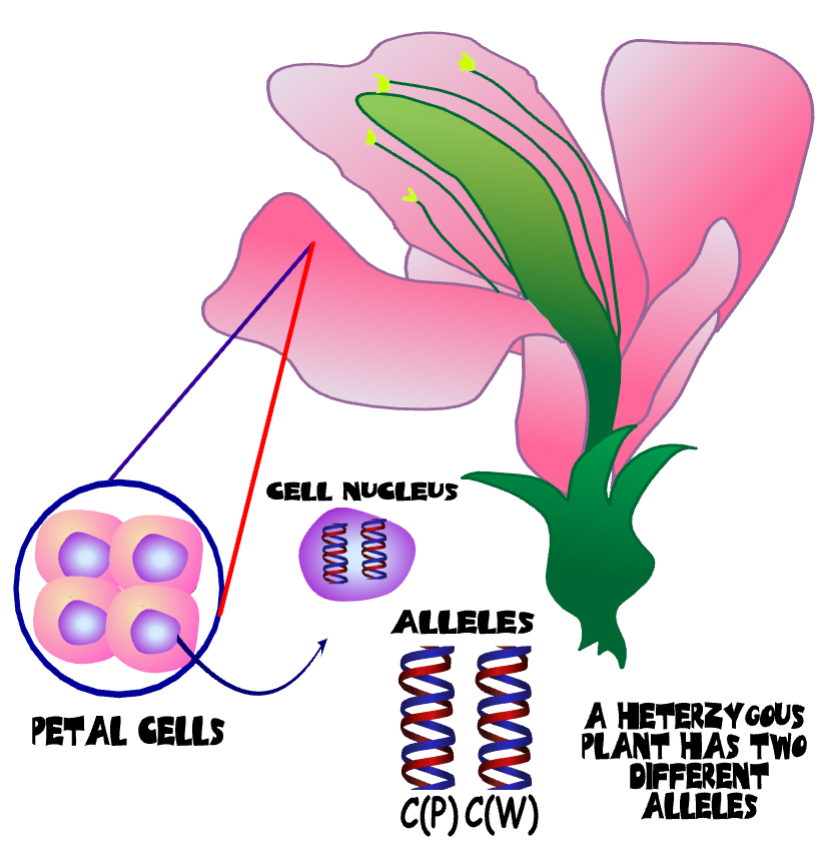
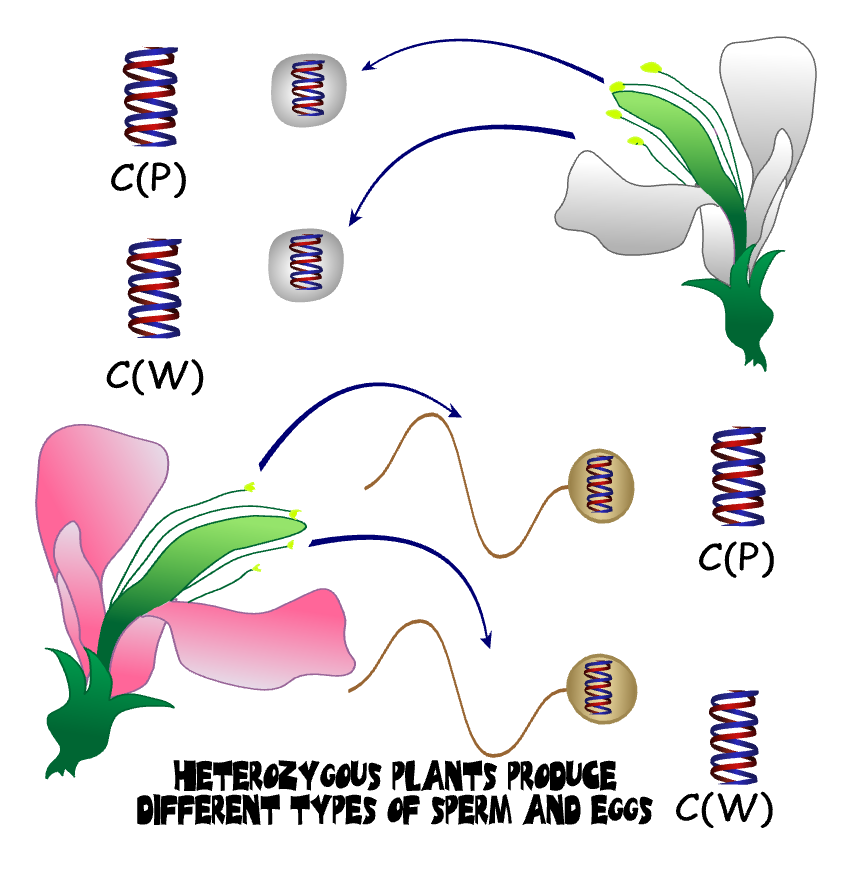
If you remember, sperm and egg cells carry half a set of genes. In our case of the flowers, this means that a male or female heterozygote flower produces different types of egg and sperm cells. For example, a male flower with a pink allele and white allele can only produce two types of sperm cells. One that contains either a single pink or single white allele.
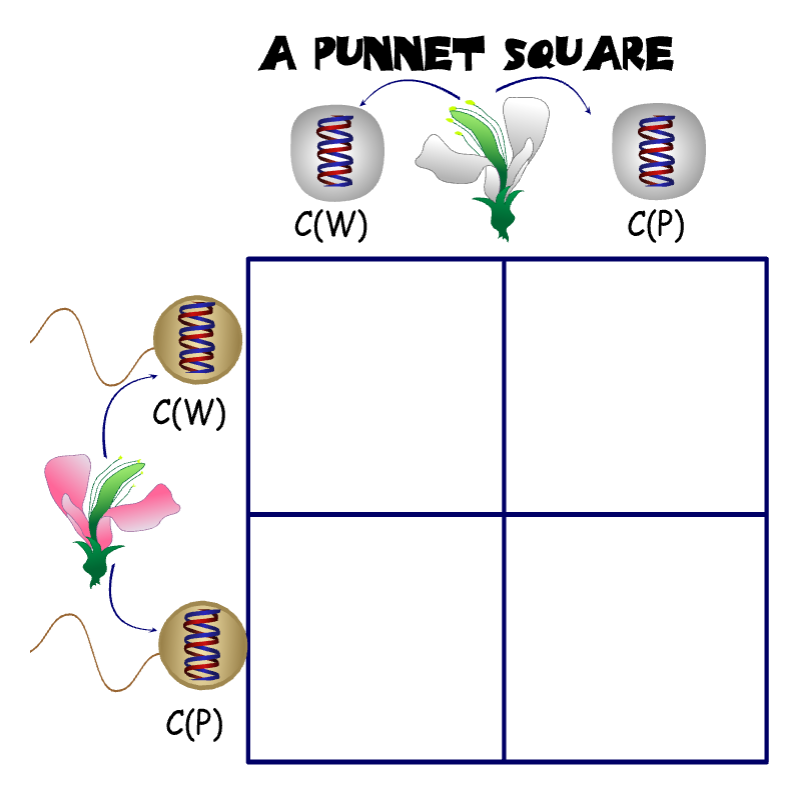
If both a male and female flower that are heterozygous for a given trait (flower color) mate, then a number possibilites arise when considering how the children will look. These possibilites can be fully seen if we use a tool called a punnett’s square. The way it works is cool. You simply line up the different sperm and egg cells on each side of a square. You then mate each sperm cell with a single egg cell to see what the kid would look like. Each smaller square is a possibilty or an event that would yield a future child.
Geneticists, people who study and work with genes, have other powerful tools besides the punnet’s square. The geneotype is one of them. The geneotype is simply all the possible combinations that two or more allele can be written in.