


Proteins 2: Enzymes

At this point of Genetics R Us, you might have forgotten the important role of proteins in what they can do. Proteins are the workhorses of DNA. They do all the hard work for DNA, and for the genes the create them. One important piece of work that proteins do is that they act as catalysts. What is a catalyst? What do proteins have to do with catalysts? In this section of Genetics R Us, we are going to take a closer look at proteins by examining their role as catalysts.
So what is a catalyst? To understand what a catalyst is, we need to take a quick detour, and review a little chemistry. If you remember from your old chemistry days, when two chemicals react to form a single new chemical, it is called a chemical reaction. For example, if you take table salt, NaCl (sodium chloride), and mix it with water, (H2O), you get HCL, (hydrogen chloride), and Na2O.
You can try this simple chemical reaction at you home. When you mix both reactants, NaCL and H2O, almost immediately, the chemical reaction takes place. Both products, HCL and Na2O, form very fast. Extremely fast reactions like this are very important, especially when this concerns living organisms. You see, the human body has hundreds, and even thousands, of chemical reactions that take place inside it every day. Even as you read this web page, millions of chemical reactions are happening.
However, some chemical reactions may take a long time to complete. For example, iron and oxygen combine to form rust, like when a nail is rusting. It generally takes rust a very long time to form. In the industry, a large chemical company that develops chemicals for the public can’t afford very slow chemical reactions. When a product is needed, it must ready to go!! No excuses!!! This is where a catalyst comes in handy!!!! A catalyst is a substance that speeds up the rate of a chemical reaction. With a catalyst, chemical products can be formed in a short time. As it turns out, living organisms produce biological catalysts as well. These biological catalysts are called enzymes. Let’s take a look.
Did you enjoy that chemistry review.

MR. Enzyme

(That’s pronouced In-zine)

Now let’s get back to the genetics. Now that you know what a catalyst is, you can understand what an enzyme is. An enzyme is a protein that accelerates the rate of a chemical reaction. In other words, an enzyme is a biological catalyst. Let’s take a look at how a catalyst works!!!!!

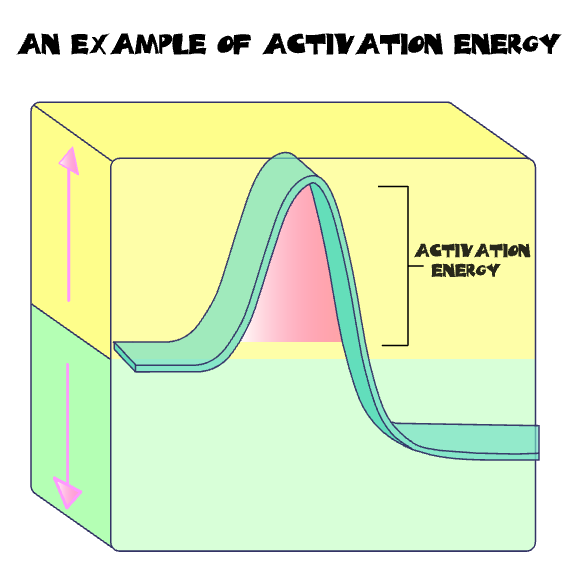
First, you need to understand a concept of activation energy or E(A). You see, in order for two reactants to form products, a certain amount of energy has to be created by the reactants. This energy is called activation energy. In the model shown toward your right, you can see this. The activation energy is represented as the green curve that resembles a hill.

hulk
Like the Hulk, a cataylst
is strong enough to make a very big difference.

What the reactants must do is that they must “reach the top of hill.” In other words, the reactants must create enough energy so they become products. Easier said than done!!!! Sometimes the reactants must face a very steep hill. In other words, the reactants must face the task of creating a large amount of activation energy. This is where a cataylst comes in handy!!!
What a cataylst does is that it actually lowers the activation energy. Simply put, a cataylst reduces the amount of activation energy which is required by the reactants so they can become products. In the model toward your right, you can see this happening. A smaller activation energy means it’s easier for the reactants to form products.
So how does a catalyst lower the activation energy? A cataylst works its magic by actually binding to either one, or both of the reactants!!! Currently it’s thought that a cataylst actually might supply some of the activation energy which required for the reactants to become to products. You can see the binding in the model toward the left!!!
In biological systems such as you and I, enzymes are the catalysts that makes everything important inside of your body happen!! Being proteins, enzymes are encoded by genes that are called enzymatic genes. Before we actually go into the genetics, we need to talk about one more little detail.
As you should know by now, your body is bag of chemical reactions. When a reaction takes place inside a living creature, then it’s called a biochemical reaction. Shown toward your right is the basic way a biochemical reaction happens in your body. What happens is that a single Chemical A, gets converted to a Chemical B. A diagram such as this is called a biochemical pathway.
So what causes Chemical A to get converted into Chemical B? This is where an catalyst comes in!!! Although it’s not quite shown in this model toward your left, a catalyst will bind to chemical A to convert it to chemical B. (This “binding” is shown by the words, “cataylst”, touching the arrow.)
In reality, a biochemical pathway is not as simple as what shown above. A basic Chemical A, may be converted a Chemical B,C,D,…..X. There may be multiple catalysts involved in the biochemical pathway. In addition, there are alternative paths a basic Chemical A may take. Shown toward your right is an example of a typical complex biochemical pathway.
Gotta find those enzymes!!!!
In fact, a big task that many scientists face today is mapping out the biochemical pathways of various important compounds that our bodies make!!!! Now, let’s finally start to talk about the genetics!!!!! At this point, your feet should be wet enough were we can finally go swimming!!!

Finaly!! The Genetics!!!

So where do we go from here!!!! To the genetics of course!!!! So what the heck are we waiting for!!!! Let’s get to it!!!!

By now you should know that enzymes are a special group of proteins that act as cataylsts within living organisms!! Because an enzyme is a protein, this means a gene encodes the enzyme!!!! When we take this into account, then our basic biochemical pathway model changes slighty!! Shown toward your right is a model of what happens at the chemical level within a living organism.
The genes that are used by your cells to make enzymes are called enzymatic genes. Let’s take a look at a real world example so you can put all of this into perspective.
If you remember, prokaroytes are single-celled organisms that live on the earth. Living in many different enviroments, prokarytes are survivors. This is because prokaryotes are equipped to handle any type of threat from their immediate outside. Toward your left, is a prokaroyte that’s swimming in different chemicals!!!!
Occasionally, a chemical or two might cross and get inside the prokaroyte. A good example is a chemical known as lactose. Lactose is not a bad chemical, however, too much of it can damage a cell.
Shown toward your right is an example of this happening to a bacteria, (prokarotye), cell.

So what a prokaroyte will do is it will convert the lactose into two different chemicals. The bacteria, (prokaroyte), does this by using an enzymatic gene that creates an enzyme called lactase. (In bacteria, lactase is actually called �- galactosidase) Lactase will basically convert lactose into both glucose and galactose. Shown toward left is an example of this.
When we look at this as a biochemical pathway, then the model toward your describes what’s going on inside the bacteria. An enzymatic gene encodes an enzyme, (in this case lactase), and then the enzyme converts the lactose into two other compounds, glucose and galactose.
Humans get lactose from drinking milk!!
This same exact process happens inside humans as well. Like a prokaryote, we too, possess a lactase gene. Humans generally obtain lactose from drinking milk. In our small intestine, humans produce large amounts of the enzyme lactase so we break down the lactose in the milk we drink. If you didn’t do this, you would develop cramps, diarrhea, and other bad things. This actually happens in some people and they are called lactose intolerant.
So how important are enzymatic genes?? Well from this section, you can see they are very important!!! Chemical reactions are very important!!! Without them, you couldn’t live. More importantly, biochemical reactions must occur at the proper times. This means your enzymatic genes must switch on at the right time so the enzyme can be ready to go to work.
It turns out that most of the genes that make up your genome are in fact enzymatic genes. As scientists continue to map out the genomes of different organisms, they are finding out that a large majority of genes that exist, encode enzymes. It’s estimated that about 90 percent of the genes that make up a basic genome produce enzymes.
How would I know an enzyme????
A bigger question that you may be asking yourself is “how would I know an enzyme if it was staring me in the face.” Well, it turns out that scientists use a simple method to distinguish enzymes from other compounds.
Here’s how it works!!! If look at the word,”lactase”, and at the word catalase, (which is another important enzyme), then you should notice both of those words have the suffix, -ase, attached to them. This is no coincedence!!! This is how you know whether you’re dealing with an enzyme!!!

You can see this at the left.

There are some exceptions to this basic rule!! For example, insulin, which is a hormone, is also an enzyme. Insulin is a hormone because it’s produced in one part of the body, and it travels to another to another part of the body. However, insulin is also an enzyme because it converts glucose to glycogen. The word insulin has no suffix, -ase, attached to it!!

For the most part, you shouldn’t have to worry about this. Most of the words that you’ll encounter will have the suffix, -ase, in use. In fact, you’ll see a lot of long words that are, in fact, enzymes. By noticing the suffix, -ase, you’ll immediately know that an enzyme is being referred to. For example, this word, Ribulose bisphosphate carboxylase oxygenase, is an enzyme. Shown toward your right are some important enzymes that living organisms produce!!!
And there you have it!!! All the basic facts about enzymes for basic understanding of genetics. Of course there is more to enzymes than what was covered here by Genetics R Us. If you’re interested in learning more about enzymes, then here are some links to other sites that deal more with enzymes!!!