


Eukaroyte Genetics
As you are reading this sentence, you’re probably saying to yourself, “what the heck does eukaroyte, (you-carry-out), means?” If you take any genetics course, then it’s almost certain that you’ll come across many terms that you may or may not understand. In short, the term eukarotye refers to all the complex living organisms that live on the planet Earth.

Of course there would be a “prokaroyte (pro-carry-out)” for every “eukaroyte“. For every “intron“, you’d have an “exon“. And for every potato, you’d have a tomato. (How’s my humor?)
Second, from here on out, Genetics R Us will many deal with the genetics of eukaryote organisms. In later concepts such as replication, mutation, etc, Genetics R Us will speak from the perspective of eukaroytes. Yeah, you guessed it!! Things are going to get a little tough, but hang in there, I’ll make it as easy as possible. With these two points in mind, let’s begin.
What’s a Prokaroyte?
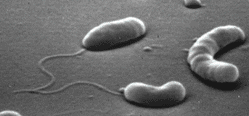
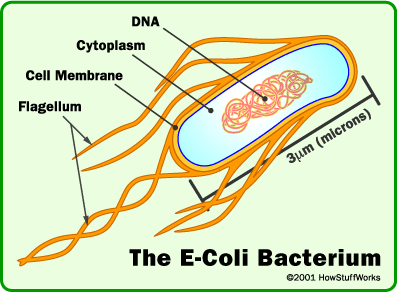
The first thing that you’re probably wondering is what the heck is a prokaroyte. Simply put, the word, “prokaroyte”, refers to all “simple” life forms that current live on the planet Earth. By simple, we mean primitive, single-cell organisms. If you’ve ever heard of bacteria, then you already know what a prokaroye is!!
You’re a Eukaroyte!!
Believe it or not, you, the reader of this webpage, are a eukaroyte. Humans are very complex eukaroytes, but a eukaroyte nonetheless. In this part, we are going to take a look at the famous eukaroytes. So let’s not beat around the bush any longer, let’s get to it!!!!!
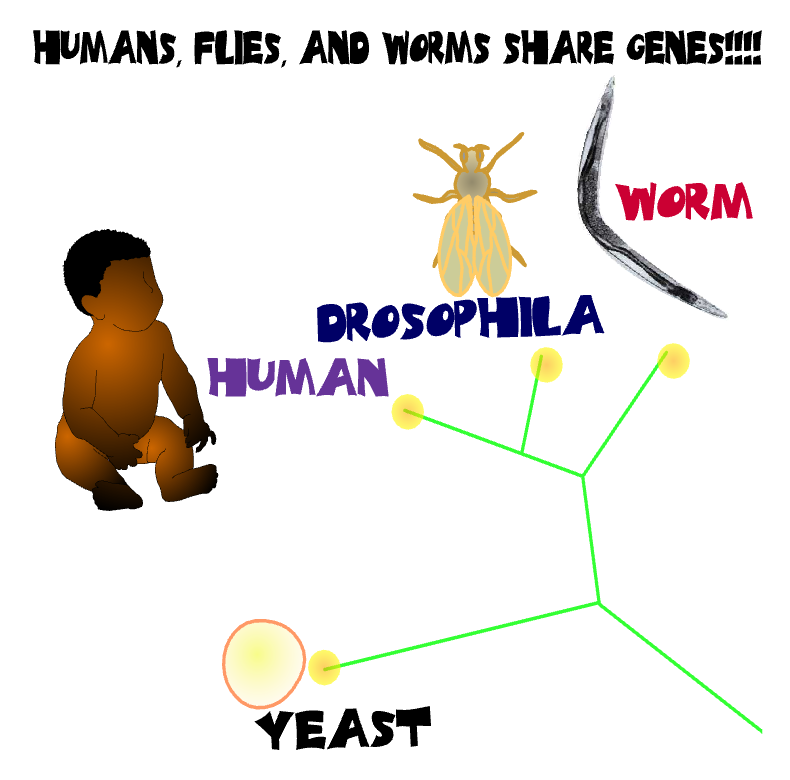
Simply put, eukaroytes are the “complex” living organisms that currently live on the Earth. This includes all life forms which are not bacteria and archea. This would include worms, flies, yeast, ameboas, plants, and us.
Shown toward your right are some of the most popular eukaroytes.
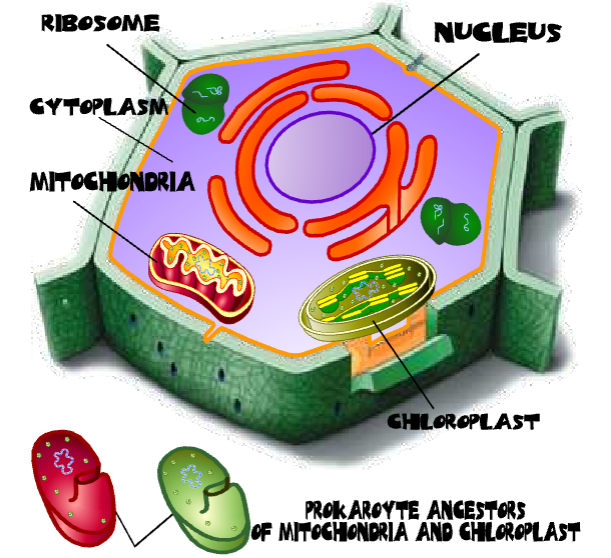
Shown toward your left is a eukaroytic plant cell. The most important feature of a eukaroyte is the presence of a nucleus. Other features include a mitochondria, chloroplast, cell wall, cytoplasms, etc. Notice both mitochondria and chloroplast are in fact prokaroytes themselves.
What’s the Point?
At this point, you’re probably saying to yourself, “What was the point of all that talk about prokaroytes and eukaroytes. I thought this was a genetics course.” Well, this is a genetics course, and now we’re ready to rumble. The basic facts about prokaroytes and eukaroytes was required so you can grasp the concepts which we are about to learn. Let’s begin with the genetics of prokaroytes.
Here’s a quick review of what these three parts are.
- A promoter is a repeating sequence of bases that is used by a cell to begin reading. This tells a cell where to begin “reading”.
- A terminator is the portion of the gene that tells the cell where and when to stop reading the gene. Without a terminator, a cell would continue reading.
- The RNA-coding sequence is the DNA that has the actual instruction for making a protein. From this section of DNA, RNA is made, and then from that RNA, the protein is generated.
The Hard Part!!
The key to understanding the genetics of eukaryotes is that eukaryotes have everything that prokaryotes have and more. Let’s take a look!!!!
If you remember your genome is the entire six feet of DNA that is contained within a sperm or egg cell. This six feet of DNA contains the entire set of instructions that is used by your cells to build and construct a single human being.
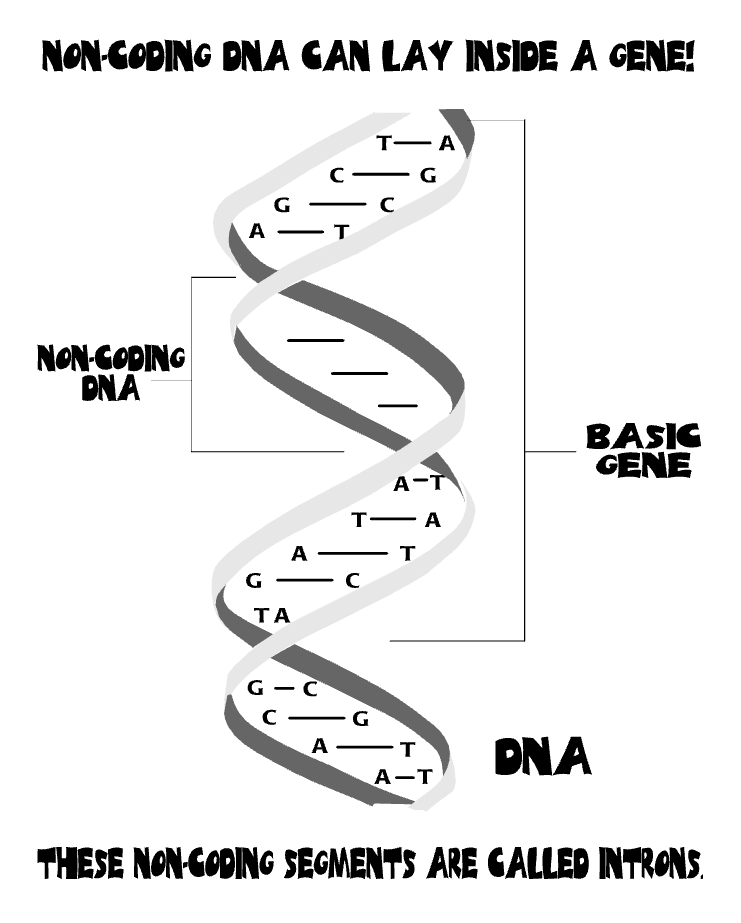
Now your genome has a set number of genes on it. The areas of DNA that are not genes are called non-coding DNA segments. These non-coding segments ARE NOT READ BY YOUR CELLS. In other words, no RNA or protein, are made from these parts. Now here’s the important part. These non-coding parts lay OUTSIDE of your genes. You can see this in the model shown toward your left.
Now here’s the part that you have to grasp. These non-coding DNA segments can also lay INSIDE of a gene. In this situation, these non-coding DNA segments are then to referred to as INTRONS. Introns are present only inside the genes of eukaroytes, not prokaryotes. The parts of a eukaroyte gene that are read by a cell are called EXONS. Now let’s take a look at a eukaroyte gene.
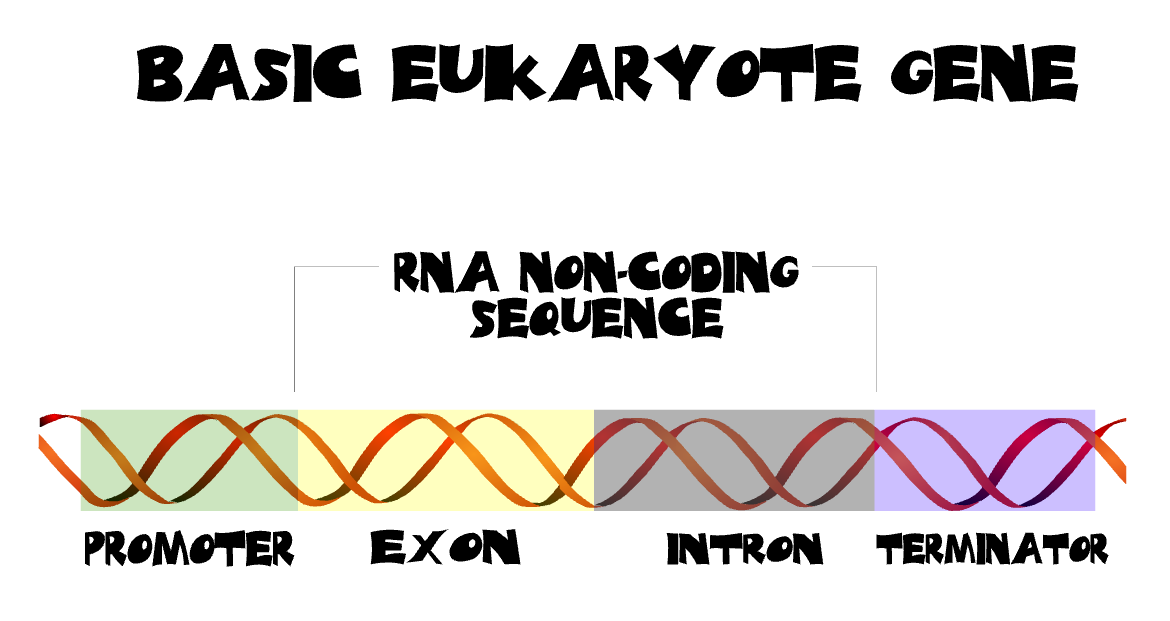
What happens is that the introns are partially read by your cells. In other words, RNA is made from the intron, but a protein is not. Shown toward your left is a model of this happening!!!
And there you have it, the genetics of eukaryote organisms. You’re probably thinking that this was a lot of information. Well, it was a lot of information, so it very important that if you don’t understand to go over this section of Genetics R Us twice and review what you have just learned. If you like, I have provided below a nice link to a quick review of the material in this section of Genetics R Us. Check it out!!!!
Here’s a link to a quick review of what we have just learned!!