
A Basic Review!!!!
Be sure to read things over if you don’t understand. Feel free to e-mail me at geneticsrus@yahoo.com.
Some important terms!!!!!
Here are some new important terms that you need to have engrained in your minds!!!!! Review these terms, and know them like the back of your hand!!!
Prokaroytes : Are “simple”, one-celled organisms that currently on the planet Earth. This includes the class of organisms known as bacteria and the new formed Archaea. An example of a bacteria would be the very popular E. coli bacteria. Shown toward your right is a basic prokaroyte cell. The important feature of a prokaroyte is the lack of a nucleus.
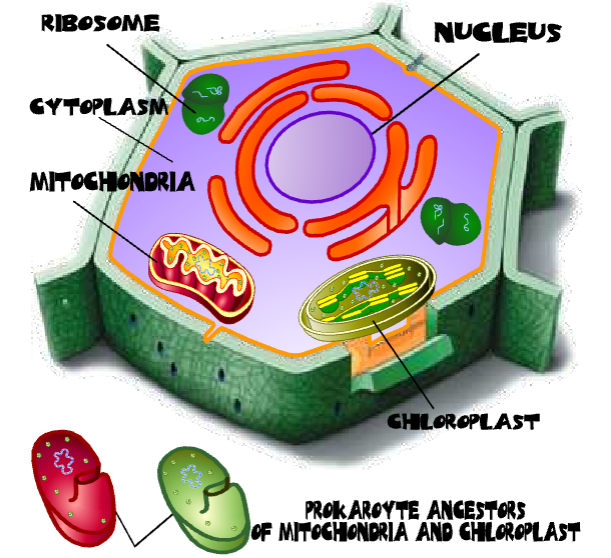
Eukaroytes: Are the “complex organisms that currently live on the planet Earth. This includes yeast, plants, flies, worms, and yes, humans!! Being the straight descendants of prokaroytes, eukaroytes have been around for 1.5 billion years!! Shown toward your right is a basic plant eukaroytic cell. The presence of nucleus is the important feature that determines a eukaroytic organism.
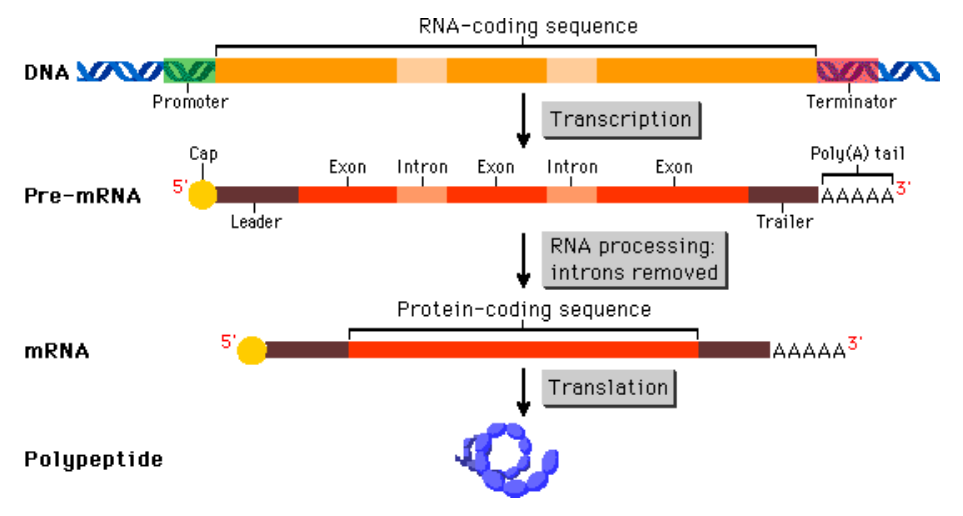
Introns: These are non-coding DNA or RNA segments that lay within genes of eukaryotic organisms. By non-coding, we mean no protein is generated from these DNA or RNA segments. From a DNA intron, as shown in toward your right, a RNA is generated, and then from that RNA intron, no protein is made. Exons: These are DNA or RNA segments that are used by a cell to generate a protein. From a DNA exon, a RNA exon is made, and from the RNA exon a protein is made.
CAP: The cap is a modified guanine (G) which is attached to the 5′ end of the exon-based RNA strand. The cap protects the RNA from being degraded by enzymes that degrade RNA from the 5′ end. (We’ll talk about enzymes in the next section.)
TAIL: This is a stretch of adenine (A) nucleotides that is attached to the 3′ end of the exon-based RNA strand. Shown toward your right is a model of this!!!!